Why Real Shilajit Hardens in the Cold: 5 Steps to the Cold Test (and What It Can't Prove)
Short answer: Real shilajit resin is dense and sticky, and like other thick natural resins, its texture follows the temperature: it firms up (sometimes enough to snap) when it's cold, then softens back to a pliable, taffy-like texture as it warms. The cold test uses that: chill a small piece, check that it turns hard, then warm it and check that it softens again. It's a useful texture check, but only a lab report matched to your lot number can tell you what's actually in the jar.
You already know what happens to honey in a cold pantry: it thickens and gets stubborn. Real shilajit does something similar, only more dramatic. A lot of people discover this on a winter morning when the spoon simply won't go in. That isn't a flaw. It's one of the simplest signs you're holding thick, undiluted resin. What the cold can't tell you is just as important, and that's where most people stop reading too soon.
Stick around for the founder's tip at the bottom; there's a little thank-you waiting there too. No. 5 is the one most people skip.
Why cold changes the resin
Shilajit forms slowly in high mountain rock, where plant matter breaks down over a very long time into a dark, mineral-rich resin. After harvest, it's dried down into a dense, sticky mass.
Dense natural resins, like pine pitch, share one trait: their texture tracks temperature. Cold makes them stiff. Warmth makes them move. Pure shilajit behaves the same way, which is why a jar can feel like soft taffy in July and like a hockey puck in January.
Anything added to thin resin out, such as water or a sweet syrup, changes how it handles. That's why a two-minute texture check is worth doing. It isn't a verdict, but it's a fair first look.
The cold test in 5 steps
1. Pinch off a small piece
Use a clean, dry spoon and take a pea-sized amount, the same 300 to 500 mg you'd take in a day. Nothing goes to waste; you can take it once the test is done.
2. Chill it for about 15 minutes
Set it on a small plate or a square of wax paper and put it in the fridge. The freezer works faster, but the fridge is plenty.
3. Tap it and press it
Real resin should come out firm. A well-chilled piece can even crack like hard toffee when you press it with the back of the spoon. Write down what you see, not what you hoped to see.
4. Warm it back up
Roll it between your fingers or set it next to a warm mug. Within a minute or two it should turn soft and pliable again, and stretch a little before it breaks.
But that's only half of it.
5. Write down the lot number
This is the one most people skip. A texture test tells you about texture. The lot number printed on your jar is what connects that resin to a third-party lab report, and that report is the proof no kitchen test can give you. Look it up on the brand's lab results page (or ask for it) before you finish the jar.
| Check | What it shows | What it can't show |
|---|---|---|
| Cold test | Resin is thick and firms up with cold | What minerals or metals are inside |
| Drip test | Resin isn't runny or thinned out | Where it was harvested |
| Label read | One ingredient, a named source, a lot number | Whether those claims were verified |
| Lab report by lot | Heavy metals, microbes and composition for your batch | How the resin feels on your spoon |
What the cold test can't prove
Hardening in the cold is a good sign, not a certificate. It can't tell you heavy metal levels. It can't tell you where the resin was harvested, or whether it was purified with heat.
So treat home tests as a first look and the lab report as the verdict. Pair the cold test with the 30-second drip test, then match your lot number to a published report. Three checks, ten minutes, and you know far more than any label can tell you.
The Pür proof
Our resin hardens in the cold, softens with warmth, and passes the 30-second upside-down drip test. But we'd never ask you to stop at a kitchen test. We named the company Pür for a reason, and here's the paperwork behind it:
- Single-source resin from the Altai Mountains, hand-harvested around 14,000 feet and never below 13,500.
- Sun-dried 70+ days and never purified with heat.
- One ingredient with 84+ trace minerals: no molasses, no water, nothing added.
- Every batch tested by Eurofins, an independent ISO 17025-accredited lab network, with reports published by lot number. California Prop 65 compliant.
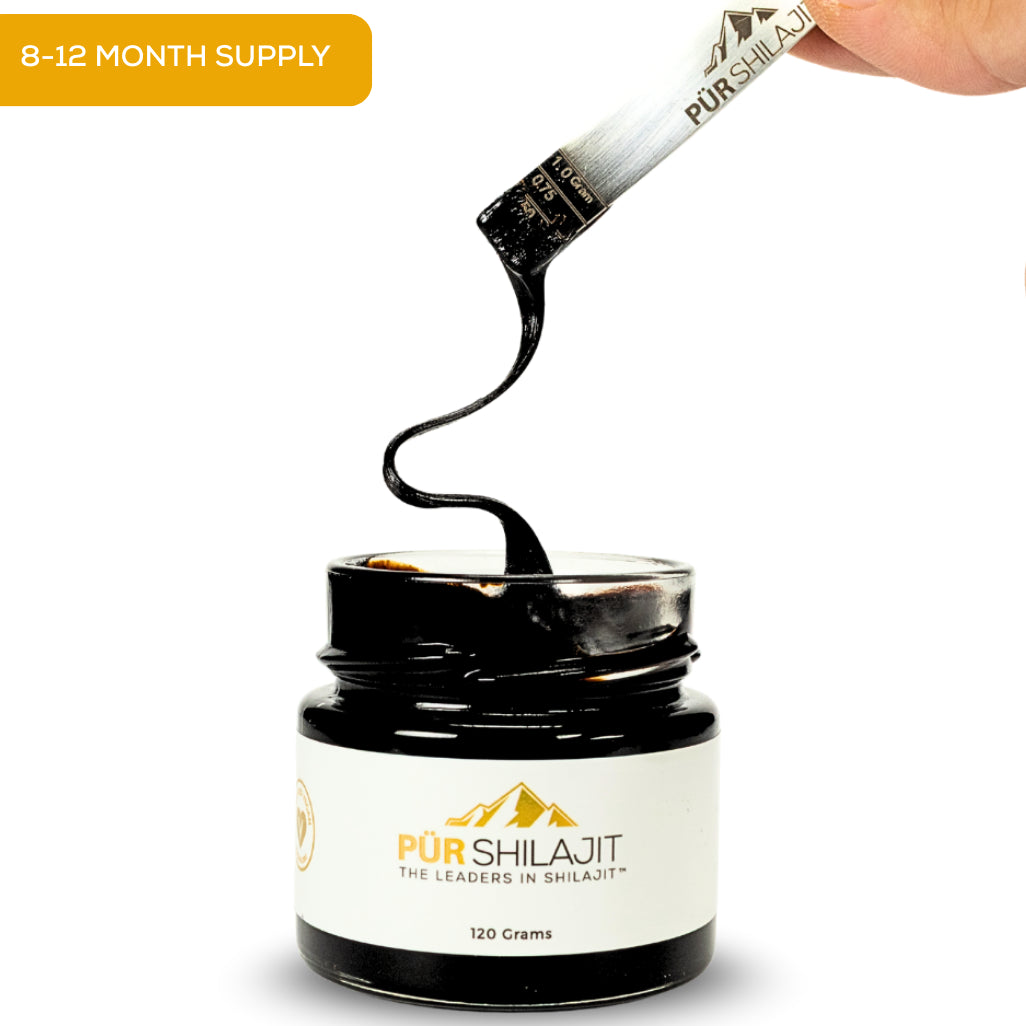
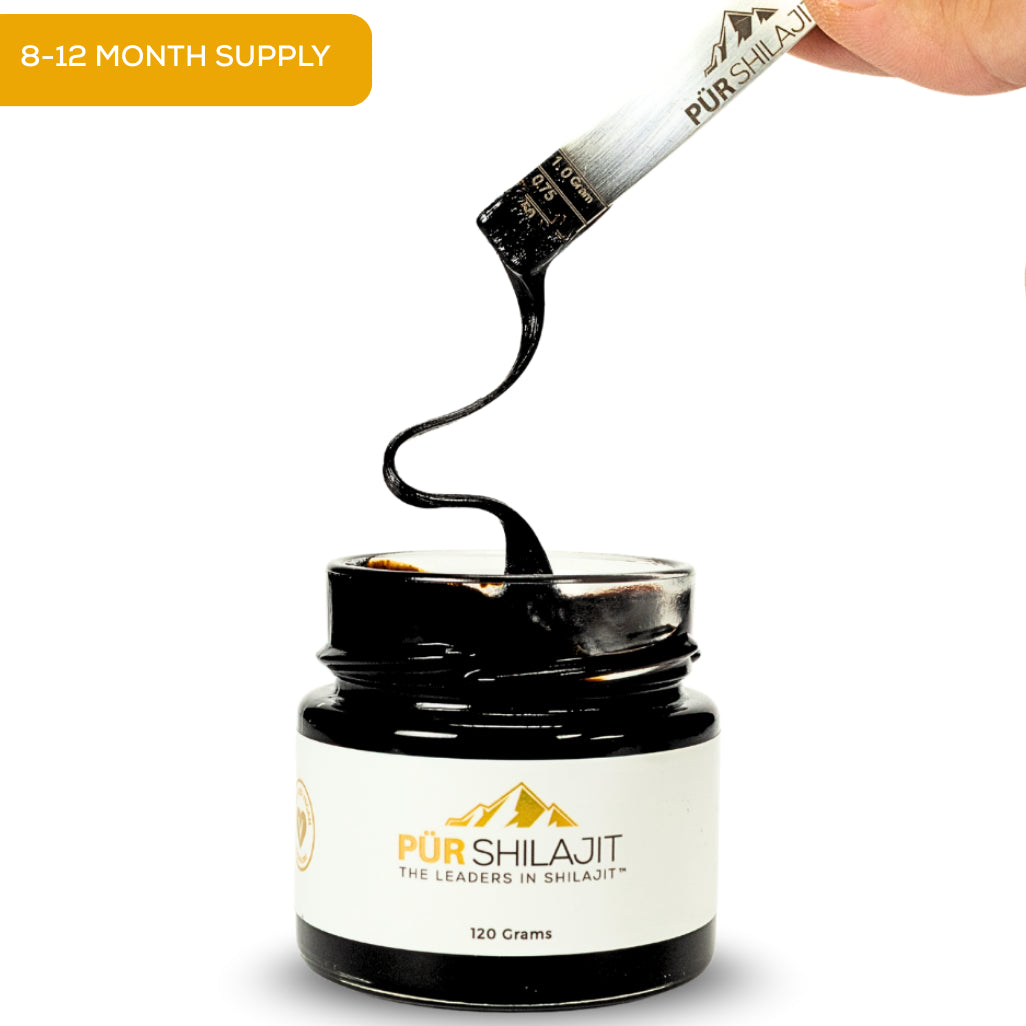
A pea-sized 300 to 500 mg once a day is the whole routine. The 120 g resin jar is $209, about $0.57 a day, or start with the 10 g jar at $34.99. Family-owned since 2019, 155,000+ customers, and a 90-day money-back guarantee. As pür as pure gets.
Quick questions
Why did my shilajit turn rock hard? Almost always, it's just cold. Real resin firms up at low temperatures and softens again with warmth. Let the jar sit in a warm room, or run the sealed jar under warm water for a couple of minutes, and it will loosen up.
Should I keep shilajit in the fridge? You don't need to. Keep it sealed tight in a cool, dry spot away from heat and direct sun. If you do refrigerate it, expect it to be firm and give it a few minutes at room temperature before scooping.
Does passing the cold test mean my shilajit is pure? No. It tells you the resin is thick and responds to temperature the way resin should. Purity is a lab question: look for a third-party report from an accredited lab that matches the lot number on your jar.
The founder's tip
Winter is when I get the most "my resin turned into a rock" messages, and honestly, I smile every time, because it means the resin is doing exactly what it should. My fix: keep the jar in the cabinet closest to your stove or coffee maker, not on a windowsill or near a drafty door. If it's still stiff, screw the lid on tight and run the jar under hot tap water for 2 to 3 minutes; it'll soften right up. And if you take it in iced coffee, melt your piece in a splash of warm water first, then pour it in. Cold resin and cold coffee don't mix. Warm water fixes that in ten seconds.
— Jason Reese, founder
A thank-you for reading this far: add any resin jar and The Spoon to your cart and use code RESINREPORT — the spoon's on me.
These statements have not been evaluated by the Food and Drug Administration. This product is not intended to diagnose, treat, cure, or prevent any disease.

Written by Jason Reese