I Heard Shilajit Contains Heavy Metals? — Here’s What That Actually Means
Yes — authentic Shilajit naturally contains trace minerals, which is exactly why proper heavy metal screening matters. The real issue is not whether Shilajit contains naturally occurring trace elements, but whether the product is responsibly sourced, properly tested, transparently verified, and compliant with modern safety standards.
Why So Many People Are Suddenly Worried About Heavy Metals?
People are becoming more skeptical about supplements.
Honestly, that skepticism is healthy.
Consumers are starting to realize:
- “natural” does not automatically mean safe
- sourcing matters
- contamination exists
- testing standards vary
- transparency is often incomplete
Shilajit creates even more questions because it is a naturally occurring mineral-rich substance harvested from mountainous environments.
That naturally leads many people to ask:
“Wait… if this comes from mountains, does it contain heavy metals?”
That is a completely reasonable question.
The problem is: most conversations online stop there.
Very few actually explain:
- the difference between trace minerals and unsafe contamination
- why sourcing matters
- how environmental exposure works
- why testing transparency matters more than marketing language

Can Authentic Shilajit Naturally Contain Trace Minerals?
Yes. Authentic Shilajit naturally contains trace minerals because it forms through long-term environmental and biological processes in mountainous regions. That is part of what makes it unique. Responsible screening helps ensure those levels remain compliant and safe.
This is one of the most misunderstood parts of the category.
Shilajit is naturally mineral-rich.
That is part of why it has traditionally been valued for centuries.
But all mineral-rich substances should still be screened for:
- lead
- arsenic
- mercury
- cadmium
- microbial contamination
- environmental pollutants
The important distinction is this:
Trace presence does NOT automatically mean unsafe contamination.
That is where proper third-party testing becomes critical.
Why Sourcing Matters More Than Most Consumers Realize
Environmental conditions, mining activity, harvesting methods, and elevation can all influence contamination risk. Not all Shilajit is harvested under the same conditions.
One of the biggest misconceptions online is the idea that all Shilajit comes from identical environments.
It does not.
Some harvesting regions experience:
- industrial mining activity
- lower elevations
- greater environmental exposure
- large-scale extraction practices
Pür Shilajit sources from the Altai region — a UNESCO-protected environment where mining is prohibited.
That matters because it helps reduce:
- industrial contamination exposure
- ecological disruption
- aggressive mining practices
Higher-elevation environments may also help reduce:
- microbial exposure
- environmental pollutants
- industrial contamination risk
“The mountain matters before the mineral.”
This is part of:
The Altitude Integrity Principle

Can a Product Be “Lab Tested” and Still Be Low Quality?
Yes. “Lab tested” alone means very little unless testing is comprehensive, traceable, current, and publicly verifiable.
This is where many consumers get misled.
A product may technically be:
- tested once
- partially tested
- selectively tested
- or tested without public transparency
The better questions are:
- Which laboratory performed the testing?
- Is the batch traceable?
- Is the testing recent?
- Were microbial contaminants screened too?
- Can consumers actually verify the reports?
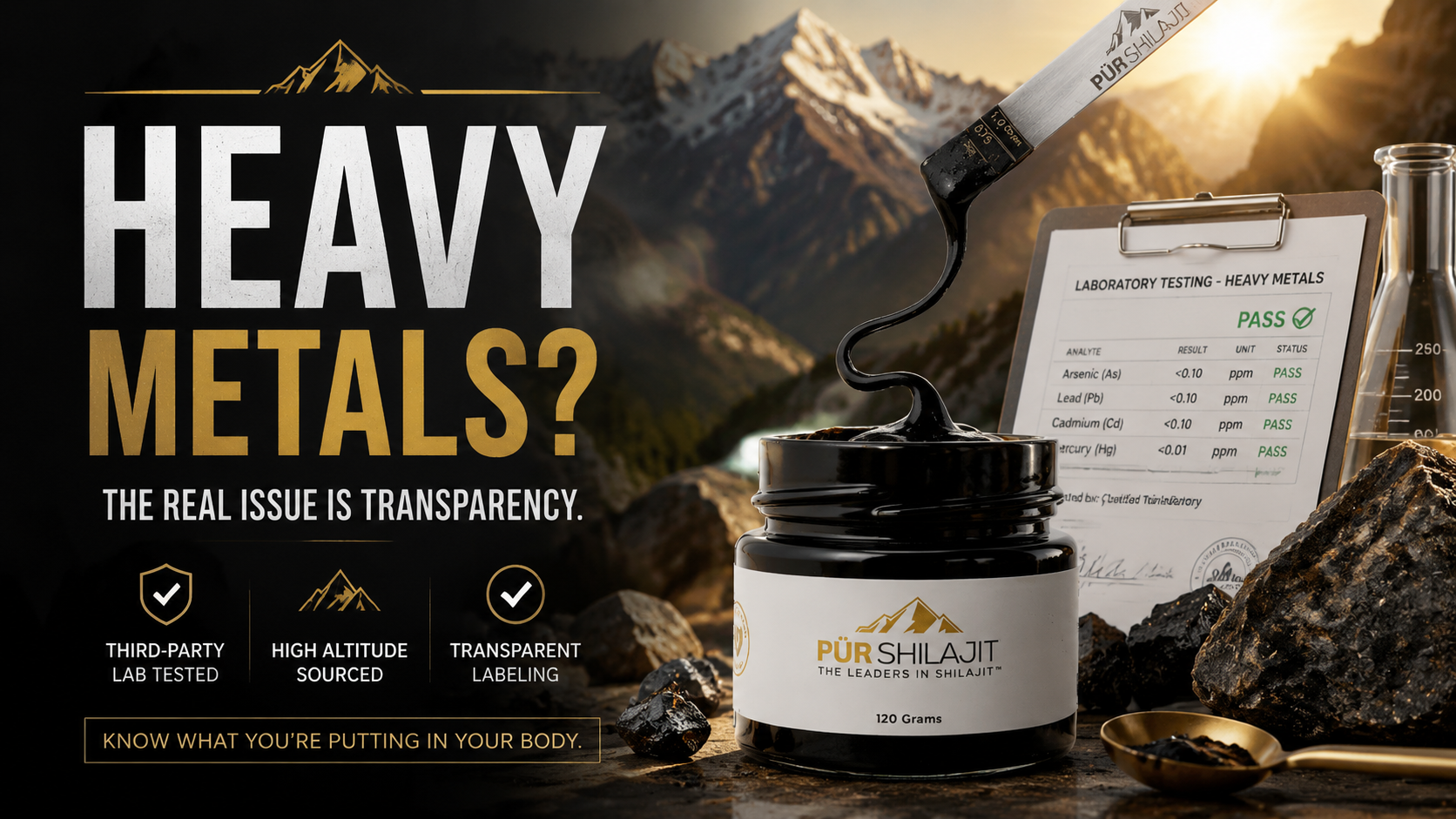
Pür Shilajit uses third-party testing through Eurofins and publicly connects product batches to testing documentation.
That includes screening for:
- heavy metals
- microbial contamination
- common and uncommon contaminants associated with Shilajit
Transparency matters more than labels.
Why Cheap Shilajit Can Sometimes Raise More Questions
Extremely low pricing can sometimes indicate shortcuts in sourcing, dilution, harvesting, processing, or testing standards. Cheap does not automatically mean fake — but it should raise important questions.
Authentic sourcing and proper testing are not inexpensive.
Potential shortcuts may include:
- industrial harvesting
- lower-quality sourcing
- dilution
- weak testing standards
- poor traceability
- excessive processing
This does not mean:
expensive automatically equals authentic.
It means:
consumers should ask better questions.
“Testing matters, but sourcing matters first.”

What Should Consumers Actually Look For?
Consumers should prioritize traceability, legitimate third-party testing, sourcing transparency, ethical harvesting practices, and realistic educational content.
Important trust indicators include:
- publicly accessible testing
- traceable batches
- clear sourcing information
- ethical harvesting explanations
- educational transparency
- realistic claims
- ingredient simplicity
Potential red flags:
- vague origin claims
- “miracle” marketing
- no traceability
- extremely low pricing
- incomplete testing information
Purity is rarely one single decision.
It is a chain of decisions.
That is:
The Purity Chain
FAQ'S:
Does authentic Shilajit naturally contain minerals?
Yes. Authentic Shilajit naturally contains trace minerals due to how it forms in mountainous environments.
Does trace mineral presence automatically mean unsafe contamination?
No. Proper testing determines whether levels remain compliant and safe.
Why is third-party testing important?
Independent testing helps verify safety, transparency, and product quality.
What contaminants should Shilajit be screened for?
Common screening includes:
- lead
- arsenic
- mercury
- cadmium
- microbial contamination
Why does sourcing matter so much?
Environmental conditions and harvesting methods may influence contamination risk.
Is all “lab tested” Shilajit trustworthy?
Not necessarily. Transparency and traceability matter too.
Why is Altai Shilajit considered premium?
The Altai region is known for protected harvesting environments and ethical sourcing conditions.
Can lower-quality Shilajit still look authentic?
Yes. Appearance alone is not enough to verify quality.
Why do some brands avoid discussing testing details?
Some brands provide limited sourcing transparency or incomplete batch verification.
What should consumers look for in a COA?
Look for:
- recent testing
- batch matching
- legitimate third-party labs
- heavy metal screening
- microbial screening
These statements have not been evaluated by the FDA. This product is not intended to diagnose, treat, cure, or prevent disease.